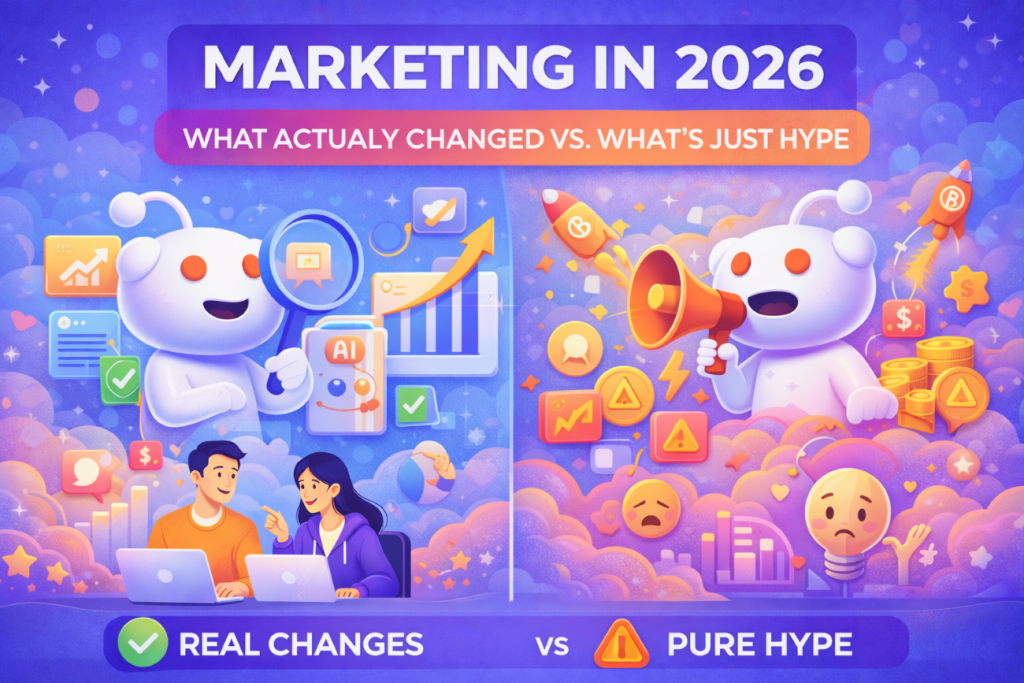
Marketing in 2026: What Actually Changed vs. What’s Just Hype 🚀
Every year, marketing headlines promise a revolution.
“This changes everything.”
“If you don’t adopt this now, you’ll be left behind.”
2026 is no different — except this time, the gap between real change and pure hype is wider than ever ⚖️.
Some shifts have genuinely reshaped how brands grow, sell, and communicate. Others look impressive in presentations but deliver very little in practice. Let’s separate the two 👇
What Actually Changed (and Matters) ✅
AI Became a Tool — Not a Strategy 🤖
AI didn’t replace marketers. It replaced inefficiency.
What changed:
- Faster content ideation and first drafts ✍️
- Better data analysis and pattern recognition 📊
- Smarter ad optimization and testing 🎯
What didn’t:
- Strategy
- Creativity
- Brand voice
- Trust-building
In 2026, the brands winning with AI aren’t those using it everywhere — they’re the ones using it intentionally.
👉 Reality check: Audiences can instantly feel when content is generic. Human insight is now a competitive advantage.
Organic Reach Is Harder — But More Valuable 📈
Yes, organic reach declined across most platforms.
No, organic marketing is not dead.
What changed:
- Algorithms reward engagement depth, not volume
- Community signals matter more than follower count
- Comments, saves, replies > likes 💬
Brands investing in useful, honest, opinionated content are still growing — just slower and more sustainably.
👉 Reality check: Viral spikes mean less than consistent trust.
B2C and B2B Lines Are Blurred 🔄
Decision-makers scroll like consumers. Consumers research like professionals.
In 2026:
- LinkedIn drives B2C discovery
- Reddit influences purchasing decisions
- TikTok educates before it entertains 🎥
People don’t switch personalities between platforms — they switch context.
👉 Reality check: If your message only works in one “marketing box,” it’s probably too rigid.
Trust Is the New Conversion Metric 🔐
Audiences are smarter, more skeptical, and overwhelmed.
What works now:
- Transparency
- Experience-based insights
- Showing the why, not just the what
- Admitting limits and mistakes 🙌
What doesn’t:
- Over-polished messaging
- “Guaranteed results”
- Artificial urgency
👉 Reality check: Trust compounds. Hype expires ⏳.
What’s Mostly Hype (or Overstated) ⚠️
“Fully Automated Marketing Systems”
Automation helps — but fully automated growth is mostly a myth.
Funnels still need:
- Clear positioning
- Real differentiation
- Continuous refinement
Without those, automation just scales mediocrity.
“One Tool That Does Everything” 🧰
Every year brings a new “all-in-one” platform.
In reality:
- Most teams use 3–5 core tools well
- Complexity kills execution
- Simpler stacks perform better long-term
👉 Tools don’t fix unclear strategy.
“New Platforms Will Replace the Old Ones”
New channels appear. Old ones evolve.
What actually happens:
- Attention fragments
- Platforms specialize
- Brands adapt messaging — not abandon channels
There’s no magic platform — only better understanding of where your audience actually pays attention.
What Smart Marketers Focus on in 2026 🧠
Instead of chasing trends, experienced marketers are doubling down on fundamentals:
- Clear positioning
- Strong brand voice
- Content with a point of view
- Community over reach
- Long-term thinking over quick wins
Technology accelerates results — but only when direction is clear.
Final Thought 💡
Marketing in 2026 didn’t change overnight.
It matured.
The biggest shift isn’t AI, platforms, or tools — it’s expectation. Audiences expect more honesty, more relevance, and more value.
The brands that win aren’t louder.
They’re clearer.
And that’s not hype — that’s reality 👌