
How Brands Manipulate Your Decisions: The Hidden Psychology Behind Modern Marketing 🧠
Every day, we make hundreds of small decisions.
What coffee to buy.
Which app to download.
What product to add to our shopping cart.
Most of us believe these decisions are completely rational.
But the truth is much more interesting — and a little unsettling.
Behind almost every purchase lies a sophisticated system of psychology, persuasion, and behavioral triggers carefully designed by marketers.
Brands don’t just sell products.
They influence how you think, what you feel, and ultimately what you choose.
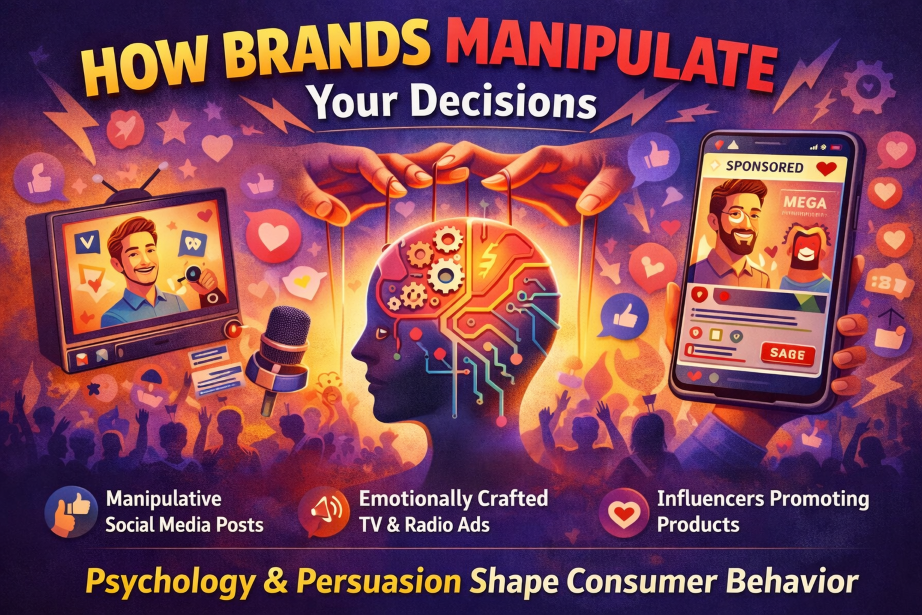
From social media posts and influencer promotions to TV commercials and radio ads, modern marketing has evolved into a powerful system that subtly shapes consumer behavior.
In this article, we explore:
How brands manipulate consumer decisions
The psychology behind persuasive marketing
The role of social media, TV, and radio advertising
Influencers and new digital marketing channels
Why some marketing promises aren’t always real
How marketers use tone of voice and emotional triggers
Let’s dive into the fascinating world behind the ads we see every day.
The Psychology Behind Consumer Manipulation
Marketing manipulation does not necessarily mean deception. In many cases, it simply means using psychological triggers to influence behavior.
Brands rely heavily on insights from behavioral economics and consumer psychology. Understanding how psychological triggers influence consumer behavior is a core part of modern marketing strategy.
Human decision-making is rarely logical. Instead, it is influenced by emotional shortcuts known as cognitive biases.
Some of the most common psychological triggers used in marketing include:
Scarcity
People value things that appear limited.
Messages like:
⏳ “Only a few items left”
🔥 “Limited time offer”
⚡ “Exclusive access”
create urgency and push consumers to act quickly.
Messages like “Only a few items left” or “Limited time offer” create urgency and push consumers to act quickly. This concept is closely related to FOMO marketing, a powerful strategy brands use to drive immediate action. (Read our full guide on FOMO Marketing and why limited offers work so well.)
Social Proof
Humans naturally follow the behavior of others.
Marketing messages often include:
⭐ Customer reviews
👥 “Millions of users worldwide”
🔥 “Trending now”
These signals create trust and reduce perceived risk.
Authority
Consumers are more likely to trust recommendations from perceived experts.
That is why brands use:
👩⚕️ Doctors in health commercials
👨🍳 Chefs promoting kitchen products
🎓 Experts in financial advertisements
Authority builds credibility — even if the authority is sometimes staged.
How Social Media Influences Consumer Decisions 📱
Social media has transformed marketing into a 24/7 influence machine.
Platforms like Instagram, TikTok, Facebook, and LinkedIn allow brands to reach consumers constantly through targeted content.
Unlike traditional ads, social media marketing feels personal and authentic.
But that authenticity can sometimes be carefully engineered.
Influencer Marketing
Influencers have become one of the most powerful persuasion tools in modern marketing.
When a trusted creator recommends a product, followers often perceive it as a personal recommendation rather than advertising.
This creates powerful influence.
For example:
A beauty influencer may promote a skincare product claiming it delivers dramatic results.
However, viewers may not realize:
- The influencer is paid
- The results may be filtered or edited
- The product effectiveness may be exaggerated
This doesn’t mean influencers always mislead audiences, but the line between recommendation and advertisement is often blurred.
The Algorithm Effect
Social media platforms also amplify marketing influence through algorithms.
Algorithms prioritize content that generates:
👍 Likes
💬 Comments
🔁 Shares
This often leads to emotionally charged content rising to the top of feeds.
As a result, brands increasingly design posts that trigger strong reactions such as excitement, fear, or curiosity.
Manipulation Through Tone of Voice 🎯
Tone of voice plays a critical role in marketing persuasion.
Different brands intentionally craft communication styles to influence perception.
Some common tones include:
Friendly and Relatable
Many brands use a casual tone to feel like a friend rather than a company.
Example:
“Hey, we made something awesome for you.”
This lowers resistance and increases trust.
Urgent and Exciting
Brands frequently create excitement around promotions.
Examples include:
🔥 “Don’t miss out!”
⚡ “Happening now!”
🚀 “Limited release!”
Excitement pushes consumers to act quickly without overthinking.
Aspirational
Luxury brands often use aspirational messaging.
Instead of selling products, they sell lifestyles and identity.
For example:
Owning a product becomes associated with:
✨ Success
💎 Status
🏆 Achievement
Consumers buy not only the product but the story behind it.
TV Advertising: The Art of Emotional Persuasion 📺
Despite the rise of digital marketing, TV ads remain incredibly powerful.
Television commercials are designed to trigger emotional responses.
Common emotional triggers include:
❤️ Family connections
😂 Humor
😢 Nostalgia
🏆 Success stories
For example, many car commercials rarely focus on technical details.
Instead, they show:
- Families on road trips
- Beautiful landscapes
- Emotional music
The car becomes associated with freedom and happiness, even though those emotions are not directly related to the vehicle itself.
Radio Advertising: Persuasion Through Imagination 🎧
Radio advertising relies heavily on storytelling and voice tone.
Without visuals, marketers must rely on imagination and emotion.
A strong radio ad might include:
- Friendly conversational tone
- Repetition of brand names
- Catchy slogans or jingles
Because listeners often hear radio ads while driving or multitasking, repetition becomes a key persuasion technique.
When Marketing Benefits Aren’t Entirely Real
One of the most controversial aspects of marketing is the promotion of benefits that may be exaggerated or simplified.
Many advertisements highlight the best possible outcome, even if typical results are different.
Examples include:
Fitness products promising rapid transformation.
Beauty products suggesting dramatic results in a short time.
Productivity tools claiming to revolutionize work efficiency.
While these claims are often technically allowed under advertising laws, they can still create unrealistic expectations.
New Digital Channels and Modern Manipulation
Marketing has expanded far beyond traditional media.
New platforms allow brands to influence consumers in increasingly subtle ways.
Native Advertising
Native ads blend seamlessly into content.
Examples include:
Sponsored articles
Recommended content widgets
Promoted posts
Because these ads look like editorial content, consumers may not immediately recognize them as advertisements.
Personalized Advertising
Modern marketing uses vast amounts of data to create personalized ads.
Brands can target individuals based on:
- Browsing history
- Interests
- Purchase behavior
- Location
This makes advertising feel extremely relevant and persuasive.
Dark Patterns
Some digital experiences intentionally guide users toward certain decisions.
Examples include:
Automatically selected subscription options
Hidden cancellation buttons
Confusing pricing structures
These techniques are designed to increase conversions, sometimes at the expense of transparency.
Why Understanding Marketing Manipulation Matters
Understanding marketing influence does not mean rejecting all advertising.
Marketing can be useful, informative, and even entertaining.
However, awareness helps consumers make more informed decisions.
When we recognize the psychological triggers used in marketing, we are better equipped to:
- Evaluate product claims
- Resist impulsive purchases
- Identify exaggerated promises
In other words, knowledge turns manipulation into informed choice.
Final Thoughts
Modern marketing is a fascinating blend of psychology, storytelling, and technology.
Brands use every available channel — social media, influencers, TV ads, radio commercials, and personalized digital campaigns — to shape consumer decisions.
Sometimes these strategies simply help consumers discover useful products.
Other times, they push emotional buttons that lead to impulsive buying behavior.
The key is balance.
Great marketing should inspire and inform, not deceive.
And the most successful brands today are those that combine persuasion with transparency and trust.
Because in the long run, trust is the most powerful marketing strategy of all.